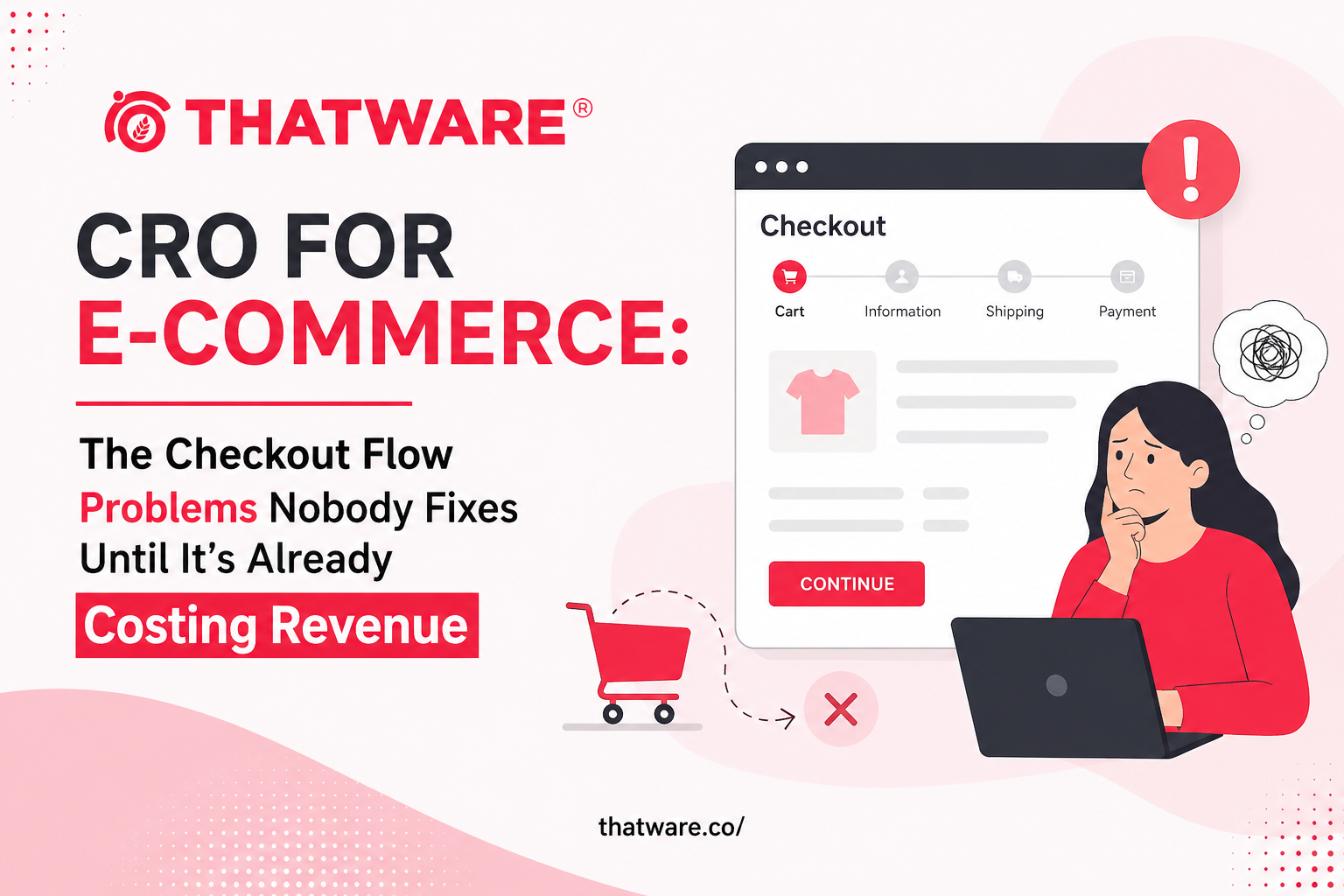
The checkout flow is the part of an ecommerce site that gets the least creative attention and causes the most revenue damage when it’s broken. Marketing teams obsess over the homepage, the product pages, the campaign landing pages. The checkout gets functional attention at launch and then gets left alone, accruing small friction points that compound into meaningful conversion losses over time.
The pattern appears consistently across ecommerce audits: a brand with genuinely good products, solid organic or paid traffic, and competitive pricing, but a checkout flow that loses a significant percentage of motivated buyers to friction that could be fixed. The lost revenue is often substantial before anyone identifies the checkout as the problem.
Part of the reason this persists is measurement. Traffic and rankings are easily visible. Checkout abandonment is less naturally surfaced unless someone is specifically looking for it. Many ecommerce teams don’t regularly audit their checkout abandonment rates by step, so the friction is invisible until it becomes dramatic enough to notice in revenue trends.
The Most Common Checkout Friction Points
There’s a consistent set of problems that shows up in checkout audits more often than almost anything else, and several of them have been known issues for years but persist across sites that haven’t prioritized fixing them.
Forced account creation before purchase is one of the most persistent conversion killers. Research has consistently shown that requiring account creation before allowing checkout increases abandonment significantly. The fix, offering guest checkout as the primary path with account creation as an optional step after purchase, has been well-documented for over a decade. And yet sites still launch with mandatory account creation as the default because it’s convenient for the business’s CRM goals, at the cost of significant conversion rate suppression.
Unexpected costs appearing late in the checkout process is another top driver of abandonment. When shipping costs, taxes, or fees are only revealed at the payment step, a meaningful percentage of users who were ready to purchase discover the total cost is higher than expected and abandon. Showing the full estimated cost, including shipping, as early as possible in the flow reduces these surprises.
Form length and complexity at the checkout level is often higher than necessary. Billing address, shipping address, payment details, account password, promotional code fields, newsletter signup. Each additional field is a decision point and a potential abandonment trigger. Auditing which fields are genuinely necessary versus which are collected out of habit produces meaningful conversion improvements.
Ecommerce cro services audits start with these fundamentals because the impact of fixing them is often immediate and significant.
Mobile Checkout Is Where Most Revenue Gets Lost
Mobile conversion rates in ecommerce are consistently lower than desktop conversion rates across most categories, and the checkout flow is usually where the gap is largest. The forms designed for desktop are frequently inadequate for mobile input. The payment interfaces that work smoothly on desktop are clunky on small screens. The multi-step flow that’s manageable on desktop requires too many taps and scrolls on mobile.
For brands where mobile traffic has grown to represent a significant portion of sessions, the mobile checkout gap often represents the largest single conversion improvement opportunity on the site. Even modest improvements in mobile checkout conversion rate produce meaningful revenue impact at scale.
Mobile checkout optimization requires specifically testing the checkout flow on actual mobile devices, not just viewing it in a desktop browser’s mobile simulation mode. The tactile experience of navigating a form on a phone, the keyboard that covers input fields, the difficulty of precise tapping on small elements, these are friction points that only become visible through real device testing.
Apple Pay, Google Pay, and similar mobile payment methods reduce the form-filling burden significantly for users who have these set up. Implementing them reduces the gap between mobile and desktop checkout conversion by removing the biggest friction point, manual card entry on a small keyboard.
Payment Failure and Error Recovery
A category of checkout friction that gets less attention than abandonment prevention is the experience when something goes wrong. Card declines, address verification failures, payment processing errors. These happen in a meaningful percentage of checkout attempts, and how the site handles them significantly affects whether the sale is recovered or lost.
The default error handling on many ecommerce sites is technically functional but conversion-hostile. Vague error messages that don’t tell the user what went wrong or how to fix it. Form fields that clear on submission failure, requiring the user to re-enter everything. No guidance on alternative payment methods when a card is declined.
Improved error recovery means clear, specific error messages that explain what failed and what to do next. Form fields that retain valid data while highlighting the field that needs attention. Proactive suggestions for alternative payment methods when a primary method fails. Persistent cart state that allows the user to pick up where they left off if they navigate away during error recovery.
Cro for ecommerce programs that address error recovery alongside abandonment prevention capture revenue that pure abandonment-prevention strategies miss.
The Post-Purchase Experience as a Conversion Factor
The checkout flow technically ends at the order confirmation page, but the post-purchase experience significantly affects whether a customer returns for a second purchase, which is often where the real lifetime value of a customer is earned.
Order confirmation pages that provide clear, complete order information, next steps, and easy access to order management reduce the support volume that comes from customers who are uncertain about what happened after checkout. Email confirmation sequences that are informative and on-brand rather than transactional and generic build the relationship that makes repeat purchase more likely.
Returns and exchange processes that are clearly communicated before purchase, not buried in fine print discovered only when they’re needed, affect purchase confidence in ways that influence conversion rate at the initial checkout. Generous, clearly communicated return policies are a conversion element as much as a logistics policy.
Building a Systematic Testing Program
The most reliably improving ecommerce checkout flows are those running systematic A/B testing programs rather than making intuition-based changes without measurement.
Testing priority should be determined by potential impact and confidence in the hypothesis. High-traffic, high-abandonment checkout steps with well-supported hypotheses about what’s causing the abandonment get tested first. Lower-traffic steps and lower-confidence hypotheses get tested later when the higher-priority wins have been captured.
Statistical rigor matters as much in ecommerce CRO as in any testing context. Tests need to run to adequate sample sizes before conclusions are drawn. Segmenting results by device type, traffic source, and customer type often reveals heterogeneous effects where a change helps one segment but hurts another.
The checkout flow is where the entire marketing funnel either pays off or doesn’t. Treating it with the same rigor and investment as the top of the funnel produces compound returns across all the acquisition channels that are sending traffic to it.