Category: Sports

  • Find the Perfect Pickleball Court Near Me: A Complete Guide

    Find the Perfect Pickleball Court Near Me: A Complete Guide

    Pickleball is no longer just a recreational sport—it has quickly become a mainstream activity across residential societies, schools, clubs, resorts, and private homes in India. As demand grows, people searching for a “pickleball court near me” are not only looking for a place to play, but also trying to understand how courts are built, what surfaces last longer, and what the real cost of pickleball court construction is.

    This guide is written from the perspective of real-world court manufacturing and installation experience, focusing on pickleball court flooring, surface performance, and long-term usability—especially in Indian outdoor conditions.

    Why the Right Pickleball Court Matters

    A pickleball court is more than painted lines on concrete. The playing experience, safety, and durability depend heavily on:

    • Proper pickleball court size and dimensions
    • Correct base preparation and slope
    • The right pickleball court surface flooring
    • Weather-resistant pickleball court material
    • Professional execution by an experienced pickleball court manufacturer

    When any one of these factors is ignored, courts develop cracks, lose grip, or become unsafe within a short period.

    Standard Pickleball Court Size & Dimensions

    Before construction begins, understanding correct measurements is critical.

    • Court size: 20 ft × 44 ft
    • Recommended play area: 30 ft × 60 ft (including run-off)
    • Net height: 36 inches at sidelines, 34 inches at center

    Accurate pickleball court dimensions ensure proper gameplay, consistent bounce, and tournament-level compatibility. Incorrect sizing often leads to awkward rallies and increased surface wear.

    Understanding Pickleball Court Flooring & Surface Systems

    Why Surface Choice Is Crucial

    The most common mistake in pickleball court construction is treating the surface as decorative paint. In reality, pickleball court flooring is a layered system designed to handle foot movement, impact, heat, and moisture.

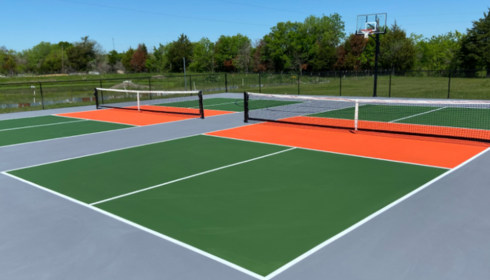
    Best Choice: Synthetic Acrylic Pickleball Court Flooring

    For Indian outdoor environments, synthetic acrylic pickleball court flooring is the most reliable solution. It offers:

    • UV resistance for color stability
    • Controlled slip resistance
    • Uniform ball bounce
    • Easy resurfacing without rebuilding
    • Long service life with minimal maintenance

    High-quality acrylic pickleball court material bonds chemically with the base, unlike tiles or temporary mats that fail over time.

    Outdoor Pickleball Court Flooring: What Works Best?

    An outdoor pickleball court flooring system must survive:

    • Extreme summer heat
    • Monsoon moisture
    • Heavy daily usage

    Acrylic-based pickleball flooring performs consistently because it is breathable, water-resistant, and flexible enough to handle minor concrete movement.

    This makes pickleball court surface flooring using acrylic layers ideal for:

    • Residential societies
    • Schools & colleges
    • Sports academies
    • Backyard courts

    Building a Home Pickleball Court: What to Know

    Interest in building a home pickleball court is rising rapidly. While space and budget vary, the fundamentals remain the same.

    Key considerations include:

    • Strong concrete base with proper slope
    • Non-slip pickleball court floor
    • Noise control through cushioned acrylic layers
    • Easy maintenance for long-term use

    A professionally installed pickleball court floor ensures safe play for all age groups, especially in residential settings.

    Pickleball Court Construction: Step-by-Step Overview

    A reliable pickleball court construction manual typically follows these stages:

    1. Site evaluation & layout marking
    2. Concrete base preparation
    3. Primer application
    4. Acrylic resurfacer layers
    5. Optional cushion coats
    6. Color coats with texture
    7. Line marking as per standards

    This systematic approach, often detailed in a pickleball court: a construction & maintenance manual, ensures surface performance and longevity.

    Cost of Pickleball Court Construction

    The cost of pickleball court construction depends on:

    • Court size and number of courts
    • Type of acrylic system (standard or cushioned)
    • Base condition (new or existing)
    • Location and site accessibility

    While budget-friendly options exist, cutting corners on pickleball court material or surface preparation usually leads to higher repair costs later.

    Choosing the Right Pickleball Court Manufacturer

    Not all contractors understand sports surface behavior. A professional pickleball court manufacturer should offer:

    • Proven synthetic acrylic systems
    • Climate-tested materials
    • Accurate court sizing and execution
    • Long-term maintenance guidance

    Working with specialists ensures that the pickleball court construction delivers both performance and durability.

    Maintenance & Longevity of Pickleball Courts

    One of the biggest advantages of acrylic pickleball floor systems is low maintenance:

    • Regular cleaning
    • Periodic inspection of lines
    • Resurfacing every few years (no demolition required)

    Following basic upkeep practices outlined in a pickleball court construction manual can extend the court’s life significantly.

    Why Choose Top Flooring

    When it comes to pickleball courts, execution matters as much as material. Top Flooring focuses on system-based synthetic acrylic pickleball court flooring, not shortcut solutions.

    • Climate-tested acrylic systems suited for Indian outdoor conditions
    • Accurate court dimensions and surface texture control
    • Proven experience across residential, school, and academy projects
    • Long-term durability with easy resurfacing support

    The result is a pickleball court that plays consistently, stays safe, and holds up year after year without frequent repairs.

    Final Thoughts

    Finding the perfect pickleball court near you isn’t just about location—it’s about how the court is built, what materials are used, and who constructs it. From accurate pickleball court dimensions to high-performance synthetic acrylic pickleball court flooring, every decision affects playability and long-term value.

    For projects that demand durability, safety, and professional execution, working with an experienced surface specialist like Top Flooring ensures courts that perform well today and remain reliable for years to come.

  • Cycle Track Flooring Solutions: Cost, Materials & Design Tips

    Cycle Track Flooring Solutions: Cost, Materials & Design Tips

    As cycling gains popularity across urban areas, schools, fitness parks, and recreational centers, the demand for well-constructed cycle tracks is increasing. A safe, durable, and cost-effective cycle track flooring ensures better rider comfort, longevity of the surface, and reduced maintenance needs. Whether it’s for public infrastructure, sports complexes, or gated communities, the right cycle track material plays a key role in achieving both functionality and safety.

    In this blog, we’ll explore the best flooring materials for cycling tracks, break down the cycle track flooring cost, and share expert cycle track design tips that can help you build a long-lasting facility.

    Why Flooring Matters in Cycle Track Design

    Unlike walking tracks or running paths, cycling tracks need smoother, harder surfaces with excellent traction. The right flooring:

    • Reduces the risk of skidding and slipping
    • Minimizes rolling resistance for speed and ease
    • Withstands high-speed, repetitive wheel motion
    • Offers weather resistance for outdoor use
    • Supports dual-use functionality in public parks

    Choosing poor materials can lead to cracks, fading, drainage problems, or even safety hazards for cyclists. That’s why choosing the correct flooring track is essential.

    Best Materials for Cycle Track Flooring

    Let’s dive into the most reliable and budget-friendly cycle track materials available in India and globally.

    1. Synthetic Acrylic Flooring

    Description: A high-performance, UV-resistant coating applied over concrete or asphalt base. This is one of the most commonly used options for outdoor sports tracks, including cycling paths.

    Advantages:

    • Slip-resistant and weatherproof
    • Available in vibrant colors
    • Requires low maintenance
    • Cost-effective for long tracks

    Ideal For: Public parks, school grounds, and society cycling lanes

    2. PU (Polyurethane) Coated Flooring

    Description: PU flooring offers a seamless, cushioned surface that performs well in high-traffic sports zones. Though more expensive, it offers long-term durability and excellent aesthetics.

    Advantages:

    • High impact and abrasion resistance
    • Smooth and seamless finish
    • Available in customizable thickness
    • Withstands UV and water damage

    Ideal For: Semi-professional cycling tracks, multi-sport arenas

    3. Rubberized EPDM Flooring (for Hybrid Tracks)

    Description: Rubber flooring, particularly EPDM, is used where walking and cycling are combined—ideal for shared spaces in parks.

    Advantages:

    • Cushioned surface reduces injury risk
    • Good grip for tires and footwear
    • Eco-friendly and weather resistant

    Ideal For: Jogger-cyclist hybrid lanes in fitness parks

    4. Asphalt with Acrylic Topcoat

    Description: Basic asphalt paving with an added acrylic finish is a budget alternative for extensive tracks.

    Advantages:

    • Durable and cost-efficient
    • Allows quick installation
    • Topcoat provides added slip resistance

    Note: Not ideal for high-speed or competitive cycling areas due to its relatively hard and rigid base.

    Factors That Influence Cycle Track Flooring Cost

    Before budgeting for your cycling track project, consider the following key pricing factors:

    • Track Length & Width: Larger areas = more material and labor
    • Type of Base: Asphalt is cheaper than concrete; both affect material selection
    • Material Grade & Thickness: Thicker coatings offer better durability but cost more
    • Drainage & Slope Needs: Extra work may be required in low-lying areas
    • Color & Custom Markings: Premium paints and branding increase costs

    For basic community cycling tracks, you can achieve a quality surface for under ₹500 per sq. meter using acrylic flooring.

    Key Cycle Track Design Tips

    Designing the layout correctly is just as important as choosing the right materials. Below are essential planning factors:

    1. Track Width & Dimensions

    • Single-lane width: 2 to 2.5 meters
    • Dual-lane width: 3 to 3.5 meters
    • Leave buffer zones at edges to prevent accidents

    2. Curvature and Turns

    • Use gradual curves rather than sharp angles
    • Proper banking may be needed on high-speed turns

    3. Drainage & Surface Slope

    • Slope of 1–2% is ideal to prevent water stagnation
    • Ensure smooth drainage to avoid surface degradation

    4. Safety Features

    • Add barriers or bollards in high-traffic zones
    • Use reflective paint for night visibility
    • Mark lane dividers clearly for shared tracks

    5. Sub-Base Preparation

    Where Are These Materials Commonly Used?

    Application AreaRecommended MaterialReason
    School or Residential ParksSynthetic AcrylicAffordable, easy to maintain
    Sports ComplexesPU CoatingDurable, seamless, professional-grade
    Hybrid Jogging-Cycling TracksEPDM Rubber FlooringSoft, versatile, injury-preventive
    Public Fitness ZonesAsphalt with Acrylic CoatingBudget-friendly and quick to install

    Maintenance Tips for Cycle Track Flooring

    • Clean debris and leaves regularly to maintain surface quality
    • Inspect the surface bi-annually for cracks or color fading
    • Re-coat acrylic surfaces every 3–5 years for optimum grip and color
    • Avoid heavy vehicle traffic on dedicated cycle paths

    Conclusion

    Cycle tracks are a vital part of any modern recreational or urban infrastructure. Whether you’re designing a path in a school, housing society, park, or city lane, choosing the right cycle track flooring material ensures rider safety, long-term durability, and an enjoyable riding experience.

    By balancing budget with performance and design with functionality, you can create a cycle track that supports active lifestyles and requires minimal upkeep. Acrylic, PU, and rubberized surfaces are all excellent options, and with proper planning, your project can be cost-effective and future-proof.

    If you’re looking for professional guidance or want to source high-quality materials for your flooring track project, make sure to evaluate vendors based on certifications, installation support, and warranty coverage.

  • A 360‑Degree Guide to Acrylic Flooring & Sports Court Construction

    A 360‑Degree Guide to Acrylic Flooring & Sports Court Construction

    Across India, the boom in community athletics, school leagues, and private sports academies has triggered a parallel surge in demand for resilient, high‑performance surfaces. At the heart of this shift is synthetic acrylic material—a multi‑layer system perfected for weather‑exposed environments and heavy daily play. Whether you’re planning a new facility or upgrading an old concrete slab, understanding how acrylic flooring integrates with modern sports court construction can help you deliver courts that look vibrant, last long, and keep athletes safe.

    This guest post demystifies the science, economics, and installation workflow of acrylic courts, spotlighting best practices championed by SLT Sports, a leading specialist in outdoor sports surfacing. Along the way we weave in practical tips, secondary keywords, and real‑world examples to guide facility owners, school boards, and municipal planners toward confident project decisions.

    1. What Makes Synthetic Acrylic Material a Game‑Changer?

    Synthetic acrylic material is a blend of water‑based, 100 % acrylic resins, high‑grade pigments, and accurately graded silica fillers. Layered over concrete or asphalt, it cures into a seamless, non‑porous, UV‑stable surface that resists cracks, fading, and delamination. Three performance attributes make it the surface‑of‑choice for Indian climates:

    1. Thermal Flexibility – Acrylic polymers expand and contract with temperature swings, mitigating surface cracks in scorching summers and cooler winters.
    2. Hydrophobic Resistance – The cured film sheds rain quickly, preventing waterlogging and algae growth during monsoon months.
    3. Customisable Traction – By altering silica grain size and top‑coat texture, contractors can dial in slip resistance for sports ranging from tennis to futsal and pickleball.

    2. Acrylic Flooring vs. Alternative Outdoor Surfaces

    FeatureAcrylic FlooringModular TilesPlain Concrete
    Ball Bounce ConsistencyHighMediumLow (varies)
    Cushioning (with cushion coats)15–25 % force reductionMinimalNone
    Heat ReflectivityLower (pigmented)HighVery High
    Maintenance Cycle4–5 year re‑topTile replacementsFrequent patching
    Initial CostMediumHighLow
    Aesthetic Lifespan8–10 years5–7 years1–2 years

    Synthetic Acrylic’s ability to balance upfront cost, tactile comfort, and long‑term colour stability makes it a logical upgrade over bare concrete while avoiding the steep capital outlay of interlocking tile systems.

    3. Anatomy of a High‑Performance Acrylic Court System

    1. Concrete Primer – Penetrates pores, locking acrylic layers to the slab.
    2. Acrylic Resurfacer – Fills micro‑cracks, eliminating surface undulations.
    3. Cushion Coat(s) – Rubberised acrylic blends add shock absorption (optional but popular for tennis and basketball).
    4. Colour Coats – Two pigmented layers create a dense, UV‑proof film in shades ranging from forest green to royal blue.
    5. Line Marking – High‑solids acrylic paint mixed with silica for extra grip.

    SLT Sports recommends a five‑layer build at minimum, though elite academies often add a sixth micro‑cushion layer to reduce joint fatigue during daily drills.

    4. End‑to‑End Sports Court Construction Workflow

    4.1 Site Evaluation & Drainage Design

    A topographic survey determines sub‑soil stability and slope directions. Courts are best oriented north‑south to minimise glare.

    4.2 Base Construction

    • Sub‑grade Compaction to 95 % Proctor density.
    • M30‑grade Concrete Slab 100–125 mm thick with a 1 % cross‑fall.
    • Curing for 21–28 days, followed by diamond grinding to open surface pores.

    4.3 Acrylic Surfacing

    Application proceeds during dry weather between 10 °C and 40 °C. Each coat dries in 1–2 hours, with light foot traffic permitted after 24 hours and full play after 72 hours.

    4.4 Accessories & Finishing

    • Adjustable Posts for tennis, volleyball, and badminton nets.
    • Heavy‑Duty Basketball Systems with glass backboards.
    • Galvanised Perimeter Fencing (10 – 12 ft) and LED floodlights for extended play.

    By following a strict timeline, SLT Sports teams routinely advices for the deliver multi‑sport or multi purpose court complexes in 25–35 days.

    5. Performance Metrics That Matter

    MetricAcceptable RangeTesting Method
    Surface Evenness<3 mm variation across 3 m3‑metre straight‑edge
    Slip Resistance (dry)0.60–0.80 COFASTM E303 pendulum
    Ball Rebound (tennis)90–105 % of ITF Type 3ITF CS 01/02
    Force Reduction15–25 %EN 14808

    6. Lifecycle Economics & Maintenance

    1. Weekly Cleaning – Leaf blower or soft broom to remove grit.
    2. Quarterly Wash – Low‑pressure rinse (<1500 psi) and pH‑neutral soap.
    3. Five‑Year Re‑Top – Single colour coat plus fresh line paint restores traction and brightness.
    4. Crack Repairs – Acrylic binder with silica patch for hairlines; routing and filling for structural cracks.

    Budgeting ₹60–₹80 per m² per year for upkeep keeps surfaces tournament‑ready for a decade or longer.

    7. Selecting the Right Partner: Why Facility Owners Trust SLT Sports

    • Proven Portfolio: Hundreds of basketball, tennis, futsal, and multi‑purpose courts across metro and tier‑two cities.
    • Material Integrity: Only premium, lead‑free pigments and 100 % acrylic binders—no styrene blends.
    • Warranty Assurance: Five‑year adhesion and fade guarantee on full‑system installs.
    • Speed & Scalability: Dedicated crews scale from single‑court projects to 10‑court academies without compromising quality.
    • Comprehensive Training: Post‑handover maintenance workshop for facility managers and grounds staff.

    By integrating design, construction, and after‑sales service, SLT Sports turns complex projects into hassle‑free assets that boost community engagement and sports excellence.

    Conclusion

    The synergy between synthetic acrylic material, precision acrylic flooring systems, and disciplined sports court construction delivers courts that meet modern performance benchmarks while standing up to India’s demanding weather cycles. From sub‑base compaction to final line painting, every layer influences bounce, traction, and aesthetic longevity. Partnering with seasoned specialists like SLT Sports ensures that your investment is grounded in engineering rigour, premium materials, and data‑driven quality control—unlocking years of safe, exhilarating play for athletes of every age.

  • Acrylic Badminton Court Flooring: Precision Beneath Every Rally

    Acrylic Badminton Court Flooring: Precision Beneath Every Rally

    Introduction: A Court That Matches Every Smash

    In a high-speed sport like badminton, where precision, agility, and reflexes define victory, the surface underfoot plays a critical role. At Prime Sports Solution, we bring unmatched expertise in designing and installing acrylic badminton court flooring that delivers optimal performance, safety, and durability. Whether you’re setting up a school facility, a private sports club, or a professional training center, our surfaces are engineered to meet international standards.

    Why Acrylic Flooring is Ideal for Badminton Courts

    Acrylic badminton court flooring offers a non-slip, cushioned, and weather-resistant surface that enhances foot grip, reduces fatigue, and ensures consistent shuttle movement. Unlike traditional flooring options, our synthetic acrylic systems are specifically designed to absorb shock, protect joints, and withstand the rigors of fast-paced gameplay. It’s the preferred choice for both indoor and outdoor badminton courts, combining aesthetic appeal with long-lasting utility.

    Trusted Sports Flooring Manufacturer in India

    As a reputed sports flooring manufacturer, Prime Sports Solution provides state-of-the-art materials and precise installation for high-performance sports surfaces. Our acrylic coatings are manufactured with advanced formulations that meet global benchmarks in quality, safety, and resilience. We are known across India for our professionalism, product reliability, and timely project completion.

    Features of Our Acrylic Badminton Court Flooring

    We use multi-layered synthetic sports flooring systems that include a cushioned base layer and multiple coats of textured acrylic, ensuring a seamless and uniform finish. Our flooring is suitable for all weather conditions and requires minimal maintenance while delivering a superior playing experience every time.

    Key Features:

    • Slip-resistant, cushioned surface for injury prevention
    • UV-resistant and anti-fungal properties for outdoor use
    • Available in standard badminton court colors
    • Excellent ball bounce and player movement
    • Quick installation and low curing time
    • Suitable for both recreational and professional play

    Complete Badminton Court Construction Services

    At Prime Sports Solution, we offer end-to-end badminton court construction services that include planning, base development, acrylic layering, and final finishing. Whether it’s a single court or a multi-court complex, our team ensures precision in every stage—from civil work to surface application and line marking.

    Our Construction Workflow:

    • Site survey and consultation
    • Concrete or asphalt base preparation
    • Synthetic acrylic layering with cushion coat
    • Standard court line marking
    • Final inspection and handover

    Indoor and Outdoor Applications

    Our acrylic badminton court flooring is highly adaptable for both indoor and outdoor sports flooring environments. For outdoor settings, the surface is weatherproof and durable enough to resist heat, moisture, and wear. For indoor courts, the system ensures a clean, professional finish with high grip and low glare, perfect for long training sessions or tournaments.

    Safe, Eco-Friendly Materials

    We prioritize player safety and environmental responsibility. Our flooring systems use non-toxic, low-VOC acrylics that are safe for athletes and reduce environmental impact. The anti-microbial and anti-fungal coatings protect the surface from deterioration while ensuring hygienic play areas.

    Why Choose Prime Sports Solution?

    • Years of expertise in sports infrastructure
    • Pan-India installation network
    • Customized court design and color schemes
    • Fast project turnaround with expert execution
    • Trusted by schools, sports academies, and private clubs

    Conclusion: Build a Badminton Court That Performs with You

    At Prime Sports Solution, we don’t just build courts—we build confidence beneath every footstep. Our acrylic badminton court flooring systems are trusted by athletes, coaches, and institutions across India. If you’re looking for a court that looks professional, performs consistently, and lasts for years, it’s time to choose Prime Sports Solution—the name trusted in badminton court construction and synthetic sports flooring.

  • Outdoor Tennis Courts: How to Plan, Build & Maintain Them

    Outdoor Tennis Courts: How to Plan, Build & Maintain Them

    Tennis is a timeless sport, known for its blend of power, strategy, and grace. As interest in the game continues to grow across schools, clubs, and private communities, the demand for outdoor tennis courts has surged. But before diving into construction, there are key factors you must consider—from the right flooring to budgeting and long-term maintenance. This blog breaks down everything you need to know.

    Why Choose Outdoor Tennis Courts?

    Outdoor tennis courts are ideal for areas with moderate to warm climates. They allow players to enjoy natural lighting and fresh air while practicing or competing. Whether you’re planning a community court, a school facility, or a private backyard setup, outdoor courts offer accessibility and versatility.

    However, building an outdoor tennis court requires more than just open space. It demands the right foundation, surfacing, drainage, and structural planning to ensure safety, durability, and a consistent playing experience.

    Tennis Court Flooring: What Works Best Outdoors?

    One of the most crucial components of any tennis court is the tennis court flooring. The surface directly impacts how the ball behaves and how players move. For outdoor environments, flooring must withstand harsh sun, rainfall, and temperature fluctuations.

    Synthetic Acrylic Flooring: A Reliable Choice

    Among all the available materials, synthetic acrylic flooring stands out as the most popular and practical choice for outdoor courts. Here’s why:

    • Weather Resistance: Acrylic surfaces are UV-stable and don’t fade or deteriorate quickly in the sun.
    • Low Maintenance: A synthetic court requires minimal upkeep and can be cleaned easily with water and basic tools.
    • Customizable Grip: Builders can choose between textured or cushioned finishes to suit different playing styles.
    • Shock Absorption: Cushion layers can be added to reduce strain on players’ joints, which is especially helpful for older or frequent players.

    Other options like clay or grass require significantly more maintenance and aren’t ideal for every climate.

    Cost to Build a Tennis Court in India

    Budget plays a key role when planning an outdoor court. The cost to build a tennis court in India depends on multiple factors:

    • Location and Land Preparation: If the ground requires leveling or drainage systems, expect higher costs.
    • Surface Material: Acrylic synthetic flooring is more affordable than clay or turf and lasts longer.
    • Fencing and Lighting: These are essential for safety and extended play hours.
    • Accessories: Nets, posts, umpire chairs, and court windscreens add to the overall cost.

    Estimated Cost Range:

    For a standard-sized court (78 ft x 36 ft) with synthetic acrylic flooring, the average cost ranges from ₹15 lakhs to ₹40 lakhs, depending on quality and features. Custom courts with lighting, fencing, and branding can go even higher.

    Maintenance Tips for Longevity

    Even the best outdoor tennis courts need proper care to remain in top shape. Here are a few simple steps to maintain your court:

    • Regular Cleaning: Sweep or blow off leaves, dust, and debris. Wash the court every few weeks to prevent dirt buildup.
    • Repainting Lines: Fading lines affect visibility and game accuracy. Repaint every 2–3 years or as needed.
    • Surface Inspection: Look for cracks, puddles, or loose debris. Prompt repair prevents small issues from becoming major problems.
    • Drainage Maintenance: Ensure water doesn’t pool on the surface. Clean out drainage channels regularly, especially before the monsoon season.

    With proper care, synthetic courts can last 10 to 15 years before resurfacing is required.

    Final Thoughts

    Building a quality outdoor tennis court is a smart investment for schools, housing societies, sports clubs, and even passionate individuals. The right planning, flooring choice, and maintenance schedule can ensure that the court remains functional, safe, and enjoyable for years.

    Whether you’re seeking high-performance surfaces for serious matches or a community-friendly setup for recreational play, synthetic acrylic flooring delivers on durability, performance, and value. When paired with expert installation and proper care, your outdoor tennis court will be a long-term asset for everyone who steps onto it.